
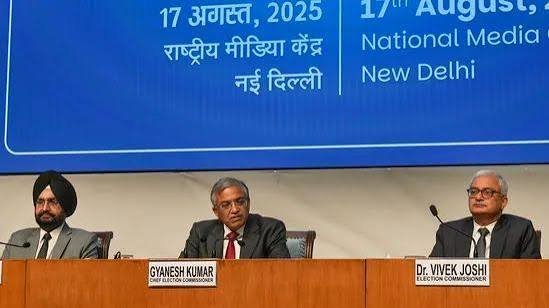
New Delhi, October 26, 2026: The Election Commission of India (ECI) has defended its decision-making process in the Supreme Court amid a controversy over the Special Intensive Revision (SIR) of electoral rolls. In an affidavit filed on Monday, the poll body said all major decisions related to the exercise were taken unanimously and argued that petitions questioning its functioning relied on newspaper reports rather than legally established evidence.
The affidavit comes amid allegations that Chief Election Commissioner Gyanesh Kumar and the Election Commission’s decision-making process faced objections from the other two commissioners, Sukhbir Singh Sandhu and Vivek Joshi. The dispute has also raised questions about the process used to register new voters and the additional declaration required during the SIR exercise.
The Commission has rejected the allegations and asked the court to dismiss the petitions. The Supreme Court is expected to take up the matter on Tuesday, October 27.
Poll Body Says Decisions Were Taken Unanimously
In its affidavit, the ECI maintained that the three orders concerning the SIR, issued in June 2025, October 2025 and May 2026, received unanimous approval from the full Commission.
The poll body also explained how files are processed before a formal decision is taken. According to its account, files are first placed before one Election Commissioner, then the other, and finally the Chief Election Commissioner. Suggestions, questions and objections raised during this process are considered before the Commission reaches its final position.
The ECI argued that remarks made while a file is being examined should not automatically be treated as evidence of disagreement over the final decision. It said formally approved decisions are recorded in the relevant files, signed by the commissioners and subsequently notified and implemented by the Commission’s secretariat.
The affidavit also challenged the use of media reports as the basis for legal proceedings. The Commission said a newspaper report cannot, by itself, establish the facts alleged in a petition. It added that it had neither released nor authorised the release of internal notes or files to news organisations.
Dispute Over Form 6 and Voter Registration
One of the central issues in the controversy concerns Form 6, the prescribed application used to register new voters. Questions were raised over whether the SIR process had effectively changed the requirements for voter enrolment by introducing an additional declaration.
The ECI has maintained that Form 6 itself was not amended. It explained that the declaration required during the SIR was a separate document and should not be treated as a change to the statutory form.
The Commission acknowledged that the online presentation of the application process could create the impression that Form 6 had been modified. It said the online process was separated into Form 6 and the additional declaration from October 21, bringing it in line with the distinction followed for physical applications.
The poll body also stated that only the Centre could amend the prescribed statutory form. Its position is that the separate declaration introduced for the revision exercise does not amount to such an amendment. The legal implications of the disputed procedure remain part of the broader case before the Supreme Court.
Commission Explains Procedure for Voters
The affidavit also addressed concerns about people whose names could not be linked to earlier electoral rolls during the revision process.
According to the Commission, Booth Level Officers (BLOs) collect the necessary information from voters’ homes and upload it to the ECINet platform for Electoral Registration Officers (EROs) to examine. The ECI said voters whose details could not be mapped to earlier rolls would not automatically be required to attend hearings. Such hearings would be reserved for exceptional cases, with online proceedings preferred where possible to reduce inconvenience.
The Commission also clarified that names cannot be added to or removed from electoral rolls without an order from the relevant Electoral Registration Officer. This, it said, is an important safeguard within the voter-registration process.
These explanations form part of the ECI’s response to concerns over the implementation of the SIR and the procedures followed when verifying voter details.
ECI Opposes Plea Against Chief Election Commissioner
The Commission has also challenged the maintainability of a plea seeking to restrain Gyanesh Kumar from functioning as Chief Election Commissioner.
The ECI referred to the legal protections governing the office, arguing that the Chief Election Commissioner can be removed only through the procedure applicable to a Supreme Court judge. It further said the law provides for decisions to be taken unanimously as far as possible, with provisions for resolving differences where unanimity cannot be reached.
The affidavit was filed as a preliminary response, with the Commission citing the intervening Dussehra holidays and reserving the right to submit a more detailed reply later.
Supreme Court Hearing Expected on October 27
The Supreme Court is scheduled to hear the matter on Tuesday. On October 5, the court had issued notice in the case but declined to grant an interim order restraining the Chief Election Commissioner.
The upcoming hearing will provide an opportunity for the court to examine the allegations and the Commission’s defence. The ECI’s affidavit represents its position in the dispute; the filing itself does not mean the court has accepted all its arguments.
The case has placed the Commission’s internal decision-making, voter-registration procedures and the implementation of the SIR under scrutiny. The next stage of the proceedings may clarify which questions require further examination and what legal steps, if any, are warranted.